Pages

Showing posts with label chutney. Show all posts

Tuesday, 5 June 2012

Afternoon Tea Sandwiches


Afternoon tea is a Great British Institution.  It is a Posh Thing.  It is something 'the Set' might have done 'properly' in the 17 and 1800s.  Messing it up is not done.

On the other hand, it is quite difficult to mess up afternoon tea.  There are only a few boxes to tick, and there are multiple acceptable ways to experiment with the content, theme and context of the event (cupcakes!  Steampunk! Picnics!  Booze!)  Here is what I reckon constitutes a 'proper' tea:

  • Teas, plural, available - preferably some to be served with milk (e.g. Assam) and some without (Lady Grey).
  • Scones, with real clotted cream, and at least two kinds of jam - a red/purple one and an orange one, minimum.
  • Cake - either individual chunks, such as Lamingtons, brownies, or other traybakes; or a single large and creamy edifice.
  • Finger Sandwiches.
    • Sandwiches must be able to be eaten in two bites or less.
    • They must have the crusts cut off, or it's not posh.
    • The shape of the eventual sandwich (triangle or rectangle) is immaterial.
    • Fillings may include spreads, but these must be savoury (not peanut butter).  
    • Faffless but uber-kitzch adornments such as cress should be rampant.
Of all the boxes, it is the sandwiches which are most often overlooked.  They do not make as photogenic an arrangement on the three-tiered stand as the cakes; it is the scones which are seen to be the true essentials, and 'tea and sandwiches' doesn't have the same ring.  Nevertheless afternoon tea is a Meal, a small meal but a Meal all the same, and all posh meals have multiple courses.  

The Approved Sandwich-Making Method (appropriated from Douglas Adams)
The chief among knives, of course, was the carving knife. This was the knife that would not merely impose its will on the medium through which it moved, as did the bread knife. It must work with it, be guided by the grain of the meat, to achieve slices of the most exquisite consistency and translucency, that would slide away in filmy folds from the main hunk of meat. The Sandwich Maker would then flip each sheet with a smooth flick of the wrist onto the beautifuly proportioned lower bread slice, trim it with four deft strokes and then at last perform the magic that the children of the village so longed to gather round and watch with rapt attention and wonder.  With just four more dexerous flips of the knife he would assemble the trimmings into a perfectly fitting jigsaw of pieces on top of the primary slice. For every sandwich the size and shape of the trimmings were different, but the Sandwich Maker would always effortlessly and without hesitation assemble them into a pattern which fitted perfectly. A second layer of meat and a second layer of trimmings, and the main act of creation would now be accomplished.


Suggested Flavours For Afternoon Tea Finger-Sandwiches

Meats
Roast beef / steak and mustard.
CurryNation Chicken: to make simple sauce, finely chop half an onion, fry in butter with 2tsp of cumin, coriander and a sprinkle of turmeric, and add coconut cream until spreadable.  Coat diced fried chicken in the mixture and assemble the sandwiches as above.
Fish
Smoked salmon, cream cheese and dill
Mackerel and horseradish
Veggie
Cucumber.  N.B. I could write a whole post on the Correct way to make cucumber sandwiches; the key thing is to peel the cucumber, slice thinly and drain the slices before assembly in a colander, scattered with salt.  This stops them going soggy.  Dress with salad dressing to increase flavour.
Cheese and chutney.

Tuesday, 3 January 2012

Horseradish

It takes some amount of work to turn these:


into this:
but somehow, over the New Year bank holiday, my man managed it.  Just occasionally he becomes obsessed with an idea, a Make or Do, in the same way that I will - and is determined to Make or Do it.  Advice will be sought from the internet, his mother, brother, and indeed all and sundry who wander into his line of sight, and he will panic about doing things 'properly'.  This is a man who will look up the 'correct' salad dressing for cucumber sandwiches.  The vagueness of advice available about dealing with horseradish did not perturb him for long, however.  Having once grasped the idea, and then the root, from his father's garden, and got said roots home, nothing would do but that homemade horseradish sauce was made. 

You will need a food processor of some sort.  Obviously in the old days this stuff had to be hand-grated, but even using the supergraters mentioned in my Orange Cake post this would take forever and be dangerously eye-watering.  He used his mother's Magimix to pulverise roughly chopped pieces of peeled root.

Having crumbed up your roots, you will need a saucepan and some creme fraiche.  At this point any mixture of the two will be either too mild or mouth-scrapingly hot; the best way we think to get the flavour correct is to very gently cook the mixture, taste-testing as you go.  Adding vinegar, a small amount of icing sugar and/or flour is also an option, although not one which I saw the application of in detail.  The key thing is correct flavour balanced with correct texture.

Once done the sauce will keep in the fridge for a few weeks, slowly getting milder and milder.  We've been eating it with cold cuts and smoked mackerel on toast.  Dyed green it's also a cheap substitute for wasabi.  Added to mustard it forms Tewksbury mustard.

Real horseradish is apparently very easy to grow in Britain; the leaves are also edible, although they have the typical popularity of tuber-top greens at the moment.  The boy's second rapidly-grasped idea was to grow our own, although he would have to indulge in some guerilla colonisation of his mother's garden to make this happen.  Maybe one day ... but for now, another seasonal jarred thing to Make and Do has been created which I'm sure will become a traditional part of our culinary year.


Saturday, 2 October 2010

Return of the Chutney / Son of Chutney


After the success of my (slightly modified) Cottage Smallholder-based damsony chutney, I decided to take the plunge and go out on my own.  Using their recipe as a basis, I designed a mild yellow version to take the place of mango chutney alongside spicier dishes.  I used half the amount of vinegar specified, which turned out to make a speedy-setting, mild-tasting mix, but it might not keep as well as the more pickled version.  We shall have to see in a few months.

Simple Yellow Plum Chunky Chutney


2lbs yellow plums (stones in)
10-11oz cooking apples, chopped (no peeling required)
10-11oz white onions
8oz (approx) apricots, chopped into at least 8 pieces each
3/4 pint red wine vinegar
8oz dark brown soft sugar
10 black peppercorns
2tsp salt
2tsp cumin
tsp ground ginger
tsp garam masala

Stone the plums and chop them into shreds.  Chop the apple, onion and apricots as small as possible, and chuck all the ingredients in a big pan.  Simmer on the hob's lowest heat for as long as it takes to thicken - you should be able to draw the spoon quickly through the chutney and catch a glimpse of the bottom of the pan.  This took 2-3 hours for me I seem to remember, but I was listening to radio 4 at the time.

Sterilise your jars and pot the chutney while everything's still hot.  Having used up all our old jars during previous efforts, I ordered a set of 32 off the internet from this site: http://www.jbconline.co.uk.  They've got a selection of large, small, Kilner and Le Parfait jars and bottles to suit everyone, at relatively knock-down bulk prices.  It's a damn sight more expensive but less faff than buying 17p curry sauce from Sainsbury's and pouring the contents down the loo, as the boyfriend once suggested!

Wednesday, 22 September 2010

Chutney update...

So, the slow cooker may after all have been a bad idea.  Its small base and lid have not been conducive to the evaporation of the vinegar; perhaps next time I shall add even less vinegar than I did - half-quantities - to speed the process.  After boiling for 7 hours, the chutney has now been jarred in good ol' recycled honey pots, sterilised by washing and putting in an oven heating up to 150 degrees C.  Hopefully once it's cooled, it'll look thicker than it is.

Mek Chutney all daaaay...

'Bees make honey, and this is an amazing thing - we never think about it but it's an amazing thing!  Do spiders make gravy?  Do earwigs make chutney?'
from the Cottage Smallholder website

I have paraphrased, but this is Eddie Izzard's wonderful stance on chutney, which I have decided to make myself.  I am not an expert earwig, so I have turned for my chutney recipe to a wonderful blog called the Cottage Smallholder.  Their recipe for plum chutney can be found here, and I have a batch of it (minus the apricots, as I didn't have any) in the slow cooker at the moment.  I am using half the amount of vinegar specified, as the slow cooker tends to conserve a lot of the liquid in any dish.

I ought here to mention two people who will have made this chutney possible.  My wonderful boyfriend D (who also prompted the invention of a chutney rather than jam, as he loves cheese) bought me the slow cooker for a birthday present about two or three years ago, for cooking at university.  It has served me well during that time, and I am delighted to discover on the internet that it may be possible to slow-boil such preserves in one rather than on the hob.
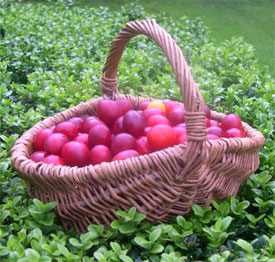
The second person is my friend V the Bearded Bat-Woman of the Night, who allowed me to plunder the extensive orchards of her Oxfordshire home for damsons, yellow plums, hard pears and cooking apples.  I shall be trying to condense this plunder into multiple jars of multiple kinds of jam and chutney over the following days, for multiple purposes.